
7 Top Picks for Best Solar Deals Products
With electricity bills soaring and climate concerns mounting, finding a solar deal that truly delivers value has become a top priority for homeowners and DIY enthusiasts alike. The right system not only slashes monthly costs but also boosts energy independence, reduces carbon footprints, and can even increase property resale value. Yet the market is flooded with options, making it easy to get lost in a maze of specs, warranties, and promotional hype. In this guide we cut through the noise, hand‑picking the seven most reliable, cost‑effective solar products currently on sale, and explain exactly what sets each one apart. By the end, you’ll know which deal fits your budget and energy goals.
7 Must‑See Solar Deals You’ll Love in 2024
We’ve hand‑picked these top solar offers to help you save money, boost efficiency, and power your home sustainably this year.
7. DOKIO 100W Portable Solar Panel

The DOKIO 100W Portable Foldable Solar Panel Kit is a lightweight, rugged solution for anyone who needs reliable off‑grid power. Weighing just 5.3 lb (≈6 lb) and folding down to 19 × 26 × 0.5 in, it slides easily into a backpack, roof rack, or van storage compartment. The monocrystalline cells deliver a solid 100 W in full sun, while the 9.84 ft (3 m) extension cable lets you position the panel in direct sunlight while keeping the controller or power station safely shaded—perfect for RVs, camping tents, trailers, or emergency backup situations.
A standalone PWM charge controller is included, offering reverse‑polarity protection, over‑charge, overload, and short‑circuit safeguards for 12 V batteries and power stations. The controller is separate, so you can upgrade or replace it without swapping the whole panel. Dual USB ports provide steady 5 V output for phones, lights, or small gadgets; they even work directly from the panel for quick top‑ups when a battery isn’t available (current may vary with sun intensity).
Note: Some portable power stations limit input to 60 W or less. In such cases the panel will still operate, but the station will only draw up to its rated maximum—this is a design limitation, not a defect. Verify your device’s input spec before purchase.
Pros
- Ultra‑light and compact; folds flat for effortless transport and storage.
- Long 3 m cable gives flexible placement, keeping electronics out of direct sun heat.
- Separate PWM controller adds robust safety features and future‑proof upgradeability.
Cons
- Output limited by the input rating of some power stations (e.g., 60 W cap).
- USB charging current depends on sunlight intensity; may be lower on cloudy days.
6. DOKIO 400W Flexible Solar Panel

The DOKIO 400 W (4 × 100 W) flexible solar panel kit delivers a powerful, lightweight solution for off‑grid adventures. Each semi‑flexible monocrystalline cell is mounted under a high‑transmission ETFE film that resists UV, hail and salt‑spray, making it ideal for RVs, marine vessels, camper‑vans and trailer roofs. The panels can bend up to 30°, so they hug curved surfaces without the bulk of glass modules. All four panels are wired with MC4 connectors, allowing you to build a 12 V or 24 V system by arranging them in series or parallel to match your PWM/MPMP controller and battery bank. Because the design is thin and light, mounting and removal are quick—perfect for mobile power needs. Remember to leave a ventilation gap and avoid direct contact with combustible materials; proper airflow keeps the panels cool and maintains peak output.
Pros
- Scalable power – four 100 W modules can be linked in series or parallel for custom 12 V/24 V setups.
- Flexible, low‑profile design – bends up to 30°, fitting roofs, decks and other irregular surfaces.
- Durable ETFE coating – higher light transmission and superior weather resistance compared with PET.
Cons
- Requires proper ventilation and non‑combustible mounting surfaces; installing on wood or fabric without a gap can reduce efficiency and pose safety risks.
- Cable routing must stay clear of the panel underside; running wires beneath can trap heat and lower performance.
5. Renogy 200W Solar Panel

The Renogy 200 W / 24 V N‑Type solar panel packs a lot of power into a surprisingly compact footprint—7.5 % smaller and 11.7 % lighter than earlier models—making it an ideal fit for the limited roof area of Class B vans, RVs, marine decks, and small off‑grid farms. Its 16‑cell‑by‑16 (16BB) N‑Type silicon delivers a market‑leading 25 % cell efficiency, which translates to more kilowatt‑hours harvested per square foot, even on cloudy days. Operating at 24 V reduces current loss and boosts overall system efficiency, while the low temperature coefficient keeps output stable in hot climates. Renogy’s engineering also minimizes micro‑cracking risk and ensures a low degradation rate (≤1 % in year 1, ≤0.4 % per year thereafter). Backed by a 10‑year material/workmanship warranty and a 25‑year performance guarantee at 80 % of rated power, this panel is built for long‑term reliability in demanding off‑grid applications.
Pros
- Compact, lightweight design – fits snugly on van roofs and tight rooftop spaces.
- High 25 % efficiency N‑Type cells – maximizes energy harvest and resists micro‑cracks.
- Hot‑climate performance – low temperature coefficient maintains output in extreme heat.
Cons
- Higher upfront cost compared with standard poly‑crystalline panels, reflecting the advanced N‑Type technology.
- Requires 24 V system for optimal efficiency, which may need additional wiring or converters for pure 12 V setups.
4. DOKIO 200W Portable Solar Panel Kit

The DOKIO 200W Portable Foldable Solar Panel Kit is a compact, high‑efficiency power solution built for on‑the‑go adventurers and emergency‑ready households. Weighing just 9.7 lb and folding down to 20 × 27 × 1.1 in, it slips into a backpack, roof rack, or trailer hatch with ease. Its monocrystalline cells deliver a reliable 200 W output, while a 9.84 ft (3 m) cable lets you position the panel in full sun while keeping the controller or power station safely shaded. The kit includes a stand‑alone PWM charge controller that safeguards 12 V batteries against reverse polarity, over‑charge, overload, and short‑circuit—so you can swap or upgrade the controller later without replacing the whole panel. Dual USB ports provide steady charging for phones, lamps, or small gadgets, and they can even draw power directly from the panel for quick top‑ups when a battery isn’t connected.
Pros
- Ultra‑portable design – lightweight and foldable, ideal for RVs, vans, boats, and backpacking trips.
- Flexible placement – 3 m cable lets you maximize sunlight while protecting sensitive electronics.
- Safe, modular charging – separate PWM controller offers robust protection and easy future upgrades.
Cons
- Some power stations limit input to 100‑150 W, so the panel’s full 200 W potential may be throttled unless paired with a compatible charger.
- USB output current can vary when the panel powers devices directly without a battery, which may affect charging speed for high‑draw gadgets.
3. Goal Zero Yeti 100W Solar Panel
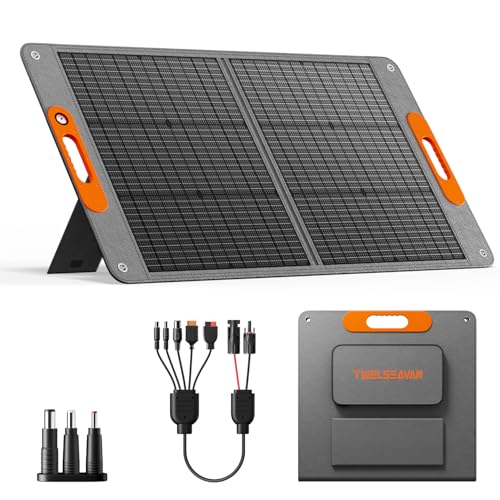
The Twelseavan 100W Portable Solar Panel delivers reliable, high‑output power wherever you go. Its upgraded A+ grade monocrystalline cells achieve a 24 % conversion efficiency, while the ETFE‑laminated case lets over 95 % of sunlight pass through, giving you the full 100 W peak output on a sunny day. A clever 2‑fold design and sturdy kick‑stand system make setup in seconds and folding just as fast—perfect for camping, RV trips, or emergency kits. The panel’s back is wrapped in high‑density polyester canvas and sealed to an IP65 rating, so rain, dust, and heat won’t slow you down.
Connectivity is a standout: an 8‑in‑1 MC4 converter cable (9.8 ft) and three DC adapters let you pair the panel with virtually any portable power station (Jackery, EcoFlow, Bluetti, Anker, etc.). On‑board charging ports include a 60 W Power‑Delivery Type‑C, an 18 W QC 3.0 USB, and a standard 5 V/3 A USB, each with smart IC protection to prevent over‑charging and overload. The package comes with the panel, MC4 cable, adapters, and a user manual, backed by a 24‑month warranty, 30‑day money‑back guarantee, and lifelong friendly support.
Pros
- High efficiency & fast charging – 24 % conversion and 60 W PD Type‑C for rapid device power‑up.
- Universal compatibility – 8‑in‑1 MC4 converter works with all major portable power stations.
- Rugged, weather‑proof design – IP65 waterproof, canvas‑backed, and foldable for any outdoor condition.
Cons
- The 100 W rating is optimal only in full, direct sunlight; performance drops in shade or low light.
- No built‑in battery; you’ll need a compatible power station or external storage to retain energy.
2. DOKIO 150W Portable Solar Panel Kit

The DOKIO 150W Portable Foldable Solar Panel Kit delivers reliable, on‑the‑go power in a sleek, travel‑ready package. The panel folds down to just 19.3 × 20.9 × 1.1 in and weighs only 7.3 lb, making it easy to slip into a backpack, RV roof rack, or van cargo area. A generous 9.8 ft (3 m) cable lets you park the panel in full sunlight while keeping the controller or power station shaded for better cooling and safer operation. The kit includes a standalone PWM controller with reverse‑polarity, over‑charge, overload, and short‑circuit protection—so you can charge 12 V batteries confidently and replace or upgrade the controller later if needed. Premium monocrystalline cells provide higher conversion efficiency and perform well in low‑light conditions, while the weather‑resistant surface tolerates sun and splashes (avoid prolonged exposure to heavy rain with the fabric case). USB ports give you a handy way to charge phones or lights directly, and the complete accessory set (extra cables, adapters, short connector, storage bag, and manual) means you’re ready to power up straight out of the box.
Pros
- Ultra‑compact & lightweight – folds small enough for solo setup and easy transport.
- Long cable & separate controller – flexible placement for optimal cooling and safety.
- High‑efficiency mono cells + weather‑resistant design – more power in weak light and durable outdoors.
Cons
- Some power stations limit solar input to 60–100 W, so the full 150 W may not be utilized without a compatible charger.
- The fabric case isn’t designed for prolonged heavy rain; it’s best to keep the panel covered in severe weather.
1. ECO-WORTHY 400W Solar Panel Set

The ECO‑WORTHY 400 W solar kit delivers four 100 W monocrystalline panels that pack a remarkable 23 % cell efficiency thanks to PERC technology. Under just four hours of direct sun, the set can generate up to 1 600 Wh a day—enough to keep a 12 V battery bank humming for lights, pumps, or small appliances. Each panel comes with a 35‑inch pre‑rated cable and a waterproof IP65 junction box with built‑in bypass diodes, so shading or low‑light conditions cause only minimal power loss.
Designed for DIY enthusiasts, the lightweight modules feature plug‑and‑play connectors and pre‑drilled mounting holes, making roof or bracket installation a breeze even for beginners. At 1.38 inches thick, the panels dissipate heat quickly, stay stable in harsh weather, and provide extra clearance for mounting hardware. The kit works seamlessly in 12 V or 24 V off‑grid, on‑grid, or hybrid systems—perfect for homes, cabins, RVs, boats, farms, or camping setups. Note that the four panels are shipped in two separate boxes for optimal protection; the second box will follow shortly after the first arrives.
Pros
- High 23 % efficiency & 1 600 Wh daily output – maximizes energy harvest in limited sunlight.
- Robust low‑light performance – IP65 junction box with bypass diodes reduces shading losses.
- Beginner‑friendly installation – lightweight, plug‑and‑play connectors and pre‑drilled mounting holes.
Cons
- Split packaging – panels arrive in two boxes, requiring a short wait for the complete set.
- Fixed 100 W per panel – may need additional modules for larger energy demands.
Buying Guide
Finding the right solar deal means balancing upfront cost with long‑term performance; the best offers deliver reliable energy at a price that makes sense for your home or business. Consider these essential factors before you commit:
- Panel efficiency and warranty: High‑efficiency panels with at least a 25‑year performance guarantee ensure you get maximum output and protection.
- Inverter quality and monitoring: A reputable inverter with real‑time monitoring lets you track production and catch issues early.
- Installation expertise and certifications: Certified installers following local codes reduce the risk of faulty setup and future maintenance costs.
- System size and scalability: Choose a system sized for your current needs but capable of expansion as your energy consumption grows.
- Total cost of ownership: Compare the quoted price, available tax credits, financing options, and expected savings over the system’s life to assess true value.
By weighing efficiency, hardware reliability, professional installation, flexibility, and overall cost, you can secure a solar deal that pays off for years to come.
Frequently Asked Questions
What factors should I compare when looking for the best solar deal?
- System size & efficiency: Make sure the panel wattage and efficiency match your energy needs.
- Price per watt: Divide the total cost by the system’s capacity ($/W) for an apples‑to‑apples comparison.
- Incentives & rebates: Check federal tax credit eligibility, state rebates, and local utility programs that can lower out‑of‑pocket costs.
- Warranty & service: Look for at least 25‑year performance warranties on panels and a 10‑year warranty on inverters and workmanship.
- Financing options: Evaluate cash purchase, loans, leases, and PPAs to see which gives the lowest levelized cost of electricity (LCOE) for you.
How can I tell if a solar promotion is truly a “best deal” or just a marketing gimmick?
- Read the fine print: Verify the total installed cost after incentives, not just the advertised “$0 down” or “$X per month” figure.
- Check the equipment brand: Reputable manufacturers (e.g., SunPower, LG, Q CELLS) usually indicate higher quality than generic “no‑brand” panels.
- Ask about hidden fees: Installation permits, utility interconnection fees, and monitoring system costs can add up.
- Compare multiple quotes: Get at least three quotes from licensed installers and calculate the net present value (NPV) of each offer.
- Look for third‑party reviews: Independent sites like SolarReviews or the Better Business Bureau can confirm whether the installer delivers on promises.
What financing or incentive programs currently provide the biggest savings on residential solar?
- Federal Investment Tax Credit (ITC): Currently 30% of the system cost (as of 2026) for residential installations, with a step‑down schedule in future years.
- State rebates & cash incentives: Many states (e.g., California, New York, Massachusetts) offer upfront rebates ranging from $0.10‑$0.30 per watt. Check your state’s DSIRE (Database of State Incentives for Renewables & Efficiency) page for the latest list.
- Solar loans: Low‑interest (3‑5% APR) loans let you own the system and claim the ITC while spreading payments over 10‑20 years.
- PACE financing: Property‑Assessed Clean Energy programs let you repay the system cost via a property tax line item, often with tax‑free interest.
- Utility net‑metering: Most utilities credit excess solar generation at the retail rate, reducing your monthly bill and improving ROI.
Tip: Combine the ITC with a state rebate and a low‑interest loan to maximize upfront savings while still owning the system for long‑term benefits.
Conclusion
Choosing the right solar solution ultimately comes down to balancing performance, price, and long‑term reliability. The best deals combine high efficiency panels with robust warranties, ensuring that the initial investment pays off through lower electricity bills and a smaller carbon footprint. Pay close attention to the reputation of manufacturers and installers, as quality support can make a significant difference over the system’s lifespan. By evaluating total cost of ownership rather than just upfront price, you can secure a setup that delivers consistent power, maximizes savings, and aligns with your sustainability goals for years to come.
