5 Best Commercial Generator Picks for Any Business
When a business depends on uninterrupted power—whether to keep production lines humming, maintain climate‑controlled storage, or simply avoid costly downtime—the choice of a commercial generator can feel like a make‑or‑break decision. A reliable unit not only safeguards revenue and reputation but also reduces maintenance headaches and fuel waste, giving operators peace of mind during storms, grid failures, or peak‑load periods. That’s why we’ve sifted through the crowded market to spotlight the five commercial generators that combine rugged durability, superior output, and smart technology at a realistic price point. In the following review, you’ll discover which models earn top marks for performance, efficiency, and support, helping you power your business confidently.
5 Top Commercial Generators You Can Trust
We’ve analyzed performance, durability, and value to bring you the five most reliable commercial generators for demanding business needs.
5. Powerscale OZB3 Ozone Generator

The Powerscale Commercial Ozone Machine OZB3 delivers industrial‑grade air purification for spaces up to 21,000 sq ft. With a staggering 250,000 mg/h ozone output, it is roughly 30 × more powerful than typical household units, blasting away stubborn odors, bacteria and viruses in factories, warehouses, hotels and large‑scale offices. A 10‑second safety delay prevents accidental exposure, while a built‑in 10‑minute auto‑ventilation cycle quickly dilutes residual ozone, making re‑entry safe and comfortable.
Control is effortless thanks to a rugged smart knob paired with a clear LCD that lets you set runtimes minute‑by‑minute—far finer than the usual 5‑minute blocks. The machine’s metal folding handle offers sturdy, portable handling, and the removable, washable filter extends service life without extra consumables. Backed by a U.S.‑based team, the OZB3 includes a 12‑month protection plan and 24/7 customer support for peace of mind.
Pros
- Ultra‑high ozone output (250,000 mg/h) cleans large areas quickly.
- Precise runtime control via smart knob & LCD for tailored treatment.
- Safety‑first design with delay start and automatic ventilation.
Cons
- The high output may be excessive for small residential rooms, requiring careful runtime adjustment.
- Unit size and weight are geared toward commercial use, so it’s less portable for frequent moving in tight spaces.
4. 0zone 3500 Sq/Ft Industrial/Commercial 0zone Generator

The 0zone Generator is a versatile ionizer designed to refresh up to 3,500 sq ft of indoor space—whether it’s a factory floor, commercial office, home living area, basement, or even a vehicle interior. Housed in a sleek, lightweight aluminum case, the unit resists rust and is easy to move thanks to its built‑in handle. The output knob lets you dial in a precise ion flow up to 10,500 mg/h, while the timer knob offers up‑to‑12 hours of programmed operation or a “HOLD” mode for continuous use. For optimal results, run the machine 1–2 times weekly in an unoccupied area, then ventilate the space for at least 30 minutes before re‑entering.
Pros
- Adjustable output & timer – tailor ion concentration and run time to match room size and usage needs.
- Portable, rust‑resistant design – aluminum body with a convenient handle makes relocation effortless.
- Broad coverage – effective in large industrial, commercial, or residential environments, creating a naturally fresh atmosphere.
Cons
- Must be operated only in unoccupied spaces; pets and people should be removed during use.
- Not sold in California and limited to a 12‑hour timer (continuous mode requires “HOLD”).
Order with confidence and reach out to our support team anytime you have questions.
3. Titan 2000 Commercial Hydroxyl Generator
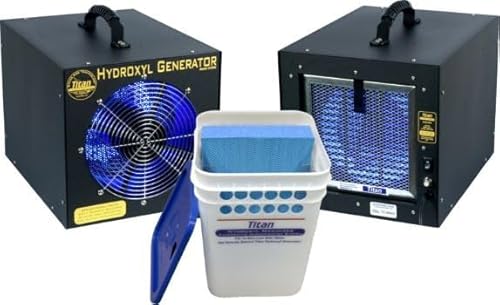
The Titan 2000 Commercial Hydroxyl Generator delivers industrial‑strength air purification for large venues, warehouses, and retail spaces. Paired with the optional Hydroxyl Maximizer Humidity Generator, it can treat up to 20,000 cu ft of air, making it ideal for open‑plan environments. The unit employs UVA light (365‑385 nm) to activate a titanium‑dioxide catalyst, producing hydroxyl radicals that oxidize odors, VOCs, mold spores, and airborne pathogens without the use of harsh chemicals. A high‑velocity fan system ensures rapid, uniform distribution of these reactive species, while the rugged black metal housing provides commercial‑grade durability and a sleek, professional appearance. Operating on a simple photocatalytic principle, the Titan 2000 converts ambient humidity into hydroxyl radicals, breaking contaminants down into harmless water and carbon dioxide, and continuously improves indoor air quality with minimal maintenance.
Pros
- Massive coverage – up to 20,000 cu ft when used with the humidity generator.
- Chemical‑free purification – UVA‑activated TiO₂ creates hydroxyl radicals, eliminating the need for sprays or filters.
- Robust construction – solid black metal casing withstands demanding commercial environments.
Cons
- Requires a separate humidity generator for maximum coverage, adding to the overall system cost.
- UVA light output may generate a faint violet glow, which could be noticeable in very low‑light settings.
2. O3Max O3-4000 Ozone Generator

The Ozone Generator 48,000 mg/h is a high‑capacity O₃ ionizer designed to eradicate stubborn odors by breaking down their molecular structure. Thanks to a conductive paste and ceramic‑coated panel, it produces up to 48 g of ozone per hour, covering more than 4,000 sq ft of space—ideal for cars, homes, boats, basements, kitchens, or even industrial areas. The unit works best in a sealed environment; simply turn the timing knob to set the desired run time, or switch to HOLD for continuous output until you manually power it off. After treatment, ventilate the area for 30‑60 minutes to let the ozone revert to safe oxygen levels.
Key features
– Strong, pungent ozone odor warns you when the unit is active (keep people, pets, and plants out).
– Must clean the odor source first for optimal results; ozone only neutralises existing smells.
– Easy‑to‑use rotary timer with OFF‑HOLD positions.
– Portable “mini” design in sleek black, suitable for both commercial and residential use.
Pros
- Massive ozone output (48 000 mg/h) removes smoke, pet, cooking, and vehicle odors far more efficiently than typical air purifiers.
- Large coverage area (up to 4 000 sq ft) makes it versatile for everything from a single car to an entire workshop.
Cons
- Must be operated only in unoccupied, sealed spaces; improper use can be hazardous to people, animals, and plants.
- Not sold in California and requires a post‑treatment ventilation period, which adds a step before the space can be re‑occupied.
1. ALL-Power 3300W Inverter Generator (Model: 2020001)

The ALL‑Power 2020001 is a 3300 W peak, 3000 W rated inverter generator built for commercial‑grade reliability while staying light enough for a single person to move. Weighing only 19.5 kg, it undercuts typical 3000 W units that tip the scales at 25 kg or more, making it easy to load into a work truck or carry between job sites. Its 143 cc engine paired with a 6.5 L fuel tank delivers up to 8 hours of continuous run‑time at 50 % load, so you can power electric drills, circular saws, air compressors, or a small office setup without constant refueling.
Noise is kept to a minimum thanks to an enclosed mute design that measures just 67.6 dB at 7 m, allowing indoor or residential‑area use without disturbing coworkers or neighbors. The generator’s reinforced metal housing and high‑temperature‑resistant components give it the durability needed for daily construction‑site work, resisting impacts, rust, and heat‑related wear.
Pros
- High power in a lightweight package – 3000 W output at only 19.5 kg.
- Quiet operation – 67.6 dB, suitable for indoor or residential environments.
- Long 8‑hour runtime at half load, reducing fuel stops and downtime.
Cons
- The 6.5 L tank, while sufficient for 8 hours, may require refueling for full‑day projects at higher loads.
- No built‑in electric start; the pull‑cord start may be less convenient for some users.
Buying Guide
When selecting a commercial generator, focus on power output, reliability, and total cost of ownership. A generator that matches your facility’s load demands while delivering consistent performance will minimize downtime and protect equipment.
- Power rating and fuel type: Choose a unit that delivers sufficient kilowatts for peak load and consider fuel availability (diesel, natural gas, propane) for continuous operation.
- Build quality and warranty: Look for heavy‑duty frames, cast‑iron engines, and a warranty of at least three years to ensure long‑term durability.
- Noise level and emissions: Verify compliance with local regulations and select models with sound‑attenuated enclosures or low‑emission technology.
- Maintenance and service support: Prefer generators with easy access to service points and a network of authorized technicians for rapid repairs.
- Price versus value: Compare upfront cost against features such as automatic transfer switches, remote monitoring, and expected fuel efficiency to gauge overall value.
By weighing these criteria, you can choose a commercial generator that delivers reliable power without hidden expenses. A well‑matched unit safeguards operations and maximizes return on investment.
Frequently Asked Questions
What factors should I consider when selecting the best commercial generator?
- Power rating: Match the generator’s kW output to the total load of your equipment (consider peak vs. continuous demand).
- Fuel type: Diesel, natural‑gas, and propane each have different availability, cost, and runtime characteristics.
- Reliability features: Look for automatic transfer switches, overload protection, and built‑in diagnostics.
- Noise level: Commercial sites often have local ordinances; choose a unit with a low dB rating or sound‑attenuating enclosure.
- Warranty & service network: Strong after‑sales support minimizes downtime.
How frequently should a commercial generator be serviced to ensure optimal performance?
- Weekly visual checks: Oil level, coolant, and fuel filters.
- Monthly testing: Run the generator under load for at least 30 minutes to verify voltage stability.
- Quarter‑yearly maintenance: Change oil, replace fuel filters, inspect battery, and test the automatic transfer switch.
- Annual professional service: Full inspection, coolant flush, and performance certification by a qualified technician.
Following this schedule helps prevent unexpected failures and extends the generator’s lifespan.
Are inverter generators a good choice for commercial applications?
- Pros:
- Clean, stable power (low THD) ideal for sensitive electronics.
- Typically quieter and more fuel‑efficient than conventional units.
- Cons:
- Generally lower power output; most inverter models top out around 5–10 kW, which may be insufficient for larger commercial loads.
- Higher upfront cost per kW compared to standard diesel generators.
Bottom line: Inverter generators work well for small‑scale commercial settings (e.g., offices, retail kiosks) where power quality matters more than sheer capacity. For heavy‑duty operations, a conventional diesel or natural‑gas generator is usually the better fit.
Conclusion
Choosing the right commercial generator hinges on understanding your operation’s power demands, reliability expectations, and maintenance capabilities. Prioritizing units with robust fuel flexibility, advanced safety features, and proven durability will safeguard productivity during outages. Consider total cost of ownership—including service contracts, warranty coverage, and fuel efficiency—to ensure long‑term value. By aligning generator capacity with critical load assessments and selecting models built for demanding environments, businesses can minimize downtime, protect equipment, and maintain seamless service delivery. Ultimately, a well‑matched generator becomes an investment in operational resilience, delivering peace of mind when power continuity matters most.