7 Best Home Backup Generators for Reliable Power
Power outages can turn a quiet evening at home into a stressful scramble for light, heat, and essential appliances, especially when severe weather or grid failures strike without warning. Choosing the right home backup generator isn’t just about picking the most powerful model; it’s about finding a unit that matches your household’s energy needs, budget, noise tolerance, and maintenance preferences, ensuring peace of mind when the lights go out. In this guide, we’ve cut through the technical jargon and consumer hype to spotlight the seven top‑rated generators that combine reliability, efficiency, and value. Read on to discover which of these standout options fits your home best.
7 Top Home Backup Generators You Can Trust
We’ve tested each model for reliability, power output, and ease of use, so you can find the perfect generator for any emergency.
7. Westinghouse WGen13500

The Westinghouse 13500‑Peak‑Watt Dual‑Fuel Portable Generator delivers reliable power when you need it most. With 13,500 W peak (10,500 W running) on gasoline and 12,500 W peak (9,500 W running) on propane, it’s ready for home backup, job‑site tools, or an RV adventure. A 500 cc 4‑stroke OHV engine—featuring a cast‑iron sleeve, automatic low‑oil and CO shutdown, and a digital hour meter—ensures durability and safe operation. The remote‑start key fob, electric and recoil start options, and a 9.5‑gal fuel tank (up to 19 hrs run time) make starting effortless. Power is delivered through two GFCI‑protected 120 V 20 A outlets, a transfer‑switch‑ready 120 V L14‑30R (30 A), and an RV‑ready 120/240 V 14‑50R (50 A), each with protective rubber covers. The package includes a 12 V battery charger, oil, funnel, tool kit, and user manual—so you’re ready to go right out of the box. Westinghouse tests each unit, meets EPA standards, and backs it with a 3‑year limited service, labor, and parts warranty plus nationwide support.
Pros
- Dual‑fuel flexibility lets you run on gasoline or propane, extending runtime and convenience.
- Remote electric start with key fob provides hands‑free operation, ideal during emergencies.
- Multiple, GFCI‑protected outlets (including transfer‑switch‑ready) support a wide range of devices safely.
Cons
- The 9.5‑gal tank, while offering up to 19 hrs of run time, may require frequent refueling under heavy loads.
- Weight and size can make transport a bit challenging without a dedicated dolly or cart.
6. WEN DF475T Portable Generator

The WEN DF475T is a versatile dual‑fuel generator that lets you switch between gasoline and propane with a simple dial, delivering 4,750 W surge (3,800 W running) on gas or 4,350 W surge (3,500 W running) on propane. Its 224 cc 4‑stroke OHV engine starts at the turn of a key thanks to the electric start, and the 4‑gal tank provides up to 11 hours of run time at half load. With a voltage selector, you can output 120 V or 240 V, making it ideal for transfer switches, home backup, or job‑site power. The generator comes ready to plug in: two 120 V GFCI outlets, a 120 V/240 V NEMA 30 A twist‑lock (L14‑30R), a 12 V DC cigarette‑lighter socket, a 47‑inch LPG hose, a wheel‑and‑handle kit for easy transport, and a bottle of oil. WEN backs it with a 2‑year warranty for peace of mind.
Pros
- Dual‑fuel flexibility – choose gasoline or propane on the fly, extending fuel options and convenience.
- 120 V / 240 V selectable output – supports both standard household circuits and higher‑power equipment without extra adapters.
- Long run time & electric start – 11 hours at half load and hassle‑free key start for reliable emergency power.
Cons
- Running wattage drops on propane – propane mode offers slightly lower continuous power (3,500 W) than gasoline, which may limit heavy‑load use.
- Weight and size – despite the wheel kit, the generator is still bulky, making storage in smaller spaces a challenge.
5. Oxseryn 4400-Watt Inverter Generator
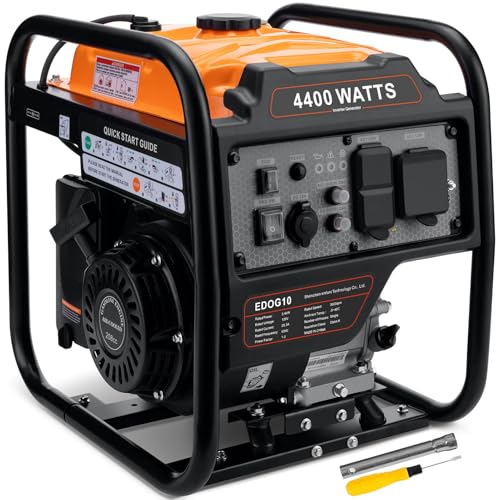
The Oxseryn 4400‑Watt Inverter Generator delivers reliable, clean power when you need it most. With a peak output of 4,400 W and a steady 3,400 W running capacity, it easily runs essential home appliances, tools, and RV electronics. The open‑frame, gas‑powered design houses a 2‑gal fuel tank that provides up to 14 hours of runtime at just 25 % load, so you can stay powered through storms or campsite evenings without constant refueling.
Thanks to true inverter technology, the generator produces stable, low‑harmonic electricity through two 120 V AC outlets, a 30 A RV plug, and a 12 V DC port—perfect for sensitive electronics, kitchen appliances, and on‑the‑road needs. Features like ECO mode, cold‑start, overload protection, and low‑oil shutdown keep the unit efficient and safe, while its EPA‑compliant engine meets strict emissions standards. Weighing only 56 lb, the compact frame makes it easy to roll or carry, and every Oxseryn unit is factory‑tested (a faint gas scent may be noticed on first use).
Pros
- High power in a lightweight package – 4,400 W peak with only 56 lb of weight.
- Versatile outlets – 2×120 V AC, 30 A RV, and 12 V DC for a wide range of devices.
- Fuel‑efficient operation – 14 h runtime at quarter load plus ECO mode reduces fuel consumption.
Cons
- Limited fuel capacity – A 2‑gal tank means you’ll need to refuel for extended, high‑load use.
- Open‑frame design – While great for ventilation, it offers less protection from rain or debris compared to fully enclosed models.
4. Oxseryn 4400 Watts Inverter Generator

The Oxseryn 4400‑Watt inverter generator delivers reliable, clean power in a compact, portable package. With a peak output of 4400 W and 3400 W of continuous power, it’s ideal for RV trips, camping adventures, and emergency home backup. The open‑frame design keeps the unit lightweight at 56 lb, making it easy to roll or carry wherever you need it. A generous 2‑gallon fuel tank paired with an on‑board fuel gauge and ECO mode lets you run up to 14 hours at 25 % load, so you stay powered through long outages or extended off‑grid stays. Multiple outlets—2×120 V AC, 1×12 V DC, and an RV 30 A port—provide flexible connections for appliances, tools, and RV systems. Despite its power, the generator runs quietly at under 72 dBA measured from 23 ft, ensuring a peaceful environment for both indoor and outdoor use. All units are factory‑tested; a faint gasoline smell on arrival is normal and not a sign of previous ownership.
Pros
- High power & versatility – 4400 W peak with multiple AC, DC, and RV outlets covers a wide range of devices.
- Long runtime – ECO mode and a 2‑gal tank give up to 14 hours of operation at low load.
- Quiet operation – Under 72 dBA keeps campsites and homes comfortable.
Cons
- Fuel capacity – The 2‑gallon tank may require frequent refilling for heavy continuous loads.
- Open‑frame exposure – While great for ventilation, it offers less protection from rain or debris compared to fully enclosed models.
3. Westinghouse WGen6500 Portable Generator
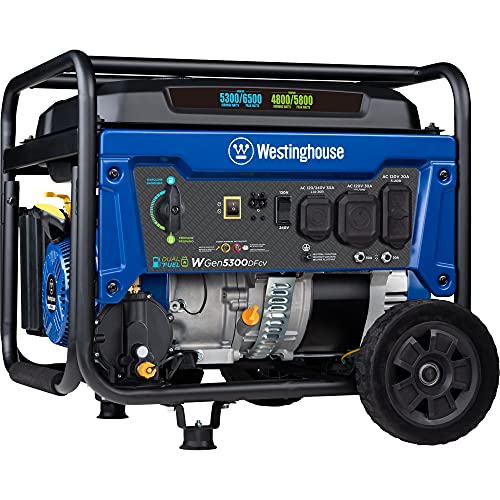
The Westinghouse 6500 Watt Dual‑Fuel Portable Generator delivers reliable power when you need it most—whether it’s a storm‑forced outage, an RV adventure, or a job‑site backup. Its 274 cc 4‑stroke OHV engine runs on gasoline (5300 W running / 6500 W peak) or propane (4800 W running / 5800 W peak) and features an automatic low‑oil and carbon‑monoxide shutdown for added safety. A 4.7‑gal fuel tank with a clear gauge provides up to 14.5 hours of continuous operation, and the 120/240 V selector switch lets you match the output to your load. Out‑of‑the‑box convenience is guaranteed with oil, an oil funnel, propane hose, tool kit, wheel kit, and a user manual—minimal assembly required. All outlets are protected by rubber covers, and the generator is transfer‑switch ready, RV‑ready, and EPA‑compliant, backed by a 3‑year limited service warranty and nationwide support.
Key Features
– Dual‑fuel capability: 5300 W/6500 W (gas) | 4800 W/5800 W (propane)
– 4.7 gal fuel tank, fuel gauge, up to 14.5 h runtime
– 120/240 V selector switch
– Three outlets: 5‑20R (120 V), TT‑30R (30 A RV), L14‑30R (30 A transfer switch) with rubber covers
– Automatic low‑oil & CO shutdown, CO sensor
– Complete starter kit (oil, funnel, hose, tools, wheels)
Pros
- Versatile power sources let you switch between gasoline and propane, ensuring you can run longer or use the fuel that’s most convenient.
- Multiple dedicated outlets cover household, RV, and whole‑house transfer‑switch needs without extra adapters.
- Built‑in safety with low‑oil and CO shutdown plus rubber‑covered receptacles reduces risk during prolonged use.
Cons
- The 4.7 gal tank, while sufficient for many hours, may require frequent refueling under heavy loads.
- At 6500 W peak, the unit is powerful but still bulkier than ultra‑compact generators, so storage space should be considered.
2. Westinghouse iGen1550 Portable Generator

The Westinghouse 14500 Peak Watt Tri‑Fuel Generator is a rugged, all‑season power solution built for larger homes, job sites, and outdoor adventures. Its 550 cc 4‑stroke OHV engine—encased in a durable cast‑iron sleeve—delivers up to 14,500 peak watts on gasoline (11,500 running), 13,500 peak watts on propane (10,500 running), and 12,000 peak watts on natural gas (9,500 running). With a 9.5‑gal fuel tank you can run up to 19 hours on gasoline, while a 20‑lb propane tank provides roughly 7 hours of continuous power. A remote electric start and transfer‑switch‑ready design make hookup effortless, and the built‑in fuel gauge keeps you informed at a glance.
Thanks to low total harmonic distortion (THD) and copper windings, the generator supplies clean, stable electricity safe for sensitive electronics—phones, computers, TVs, and medical devices. EPA‑compliant and factory‑tested, it comes with a 3‑year limited service, labor, and parts warranty backed by Westinghouse’s nationwide service network.
Pros
- Tri‑fuel flexibility – switch between gasoline, propane, or natural gas to suit availability and cost.
- High output & long run time – 14.5 kW peak power with up to 19 hours on a single tank, ideal for whole‑home backup.
- Clean power for electronics – low THD and copper windings protect sensitive devices and extend generator life.
Cons
- Weight and size – the heavy‑duty engine and large fuel capacity make it less portable than smaller units.
- Propane runtime – only about 7 hours on a full 20 lb tank, which may require more frequent refills for extended use.
1. Westinghouse iGen12500 Portable Generator

The Westinghouse 12,500‑Watt Dual‑Fuel Generator is built for emergencies and off‑grid adventures. Its 457 cc 4‑stroke OHV engine delivers 9,500 W running (12,500 W peak) on gasoline and 8,500 W running (11,200 W peak) on propane, giving you the flexibility to choose the fuel that’s most convenient. A 6.6‑gal fuel tank provides up to 12 hours of continuous power, while the digital hour meter and VFT display keep you informed of voltage, frequency, and total runtime. Remote start is handled by an included key fob, with electric and recoil start options for redundancy. The panel features two GFCI‑protected 120 V 20 A outlets, a transfer‑switch‑ready 120 V L14‑30R, and an RV‑ready 120/240 V 14‑50R, each protected by rubber covers for added safety. Out‑of‑the‑box accessories include a 12 V battery charger, oil, funnel, tool kit, and user manual, so you’re ready to power up with minimal assembly. Westinghouse backs the unit with a 3‑year limited service, labor, and parts warranty and a nationwide support network.
Pros
- Dual‑fuel versatility – switch between gasoline and propane without swapping the generator.
- Robust power output – 12,500 W peak covers heavy‑duty tools, home appliances, and RV needs.
- Convenient remote start – key fob and multiple start options mean you can run it from inside your home.
Cons
- Fuel tank size – 6.6 gal capacity limits runtime; extended use may require frequent refueling.
- Weight and size – heavy-duty construction makes it less portable than smaller, single‑fuel models.
Buying Guide
Choosing a home backup generator involves balancing power needs, reliability, and safety to ensure you stay lit during outages. Focus on the generator’s capacity, fuel type, and built‑in protections to match your household’s demands.
- Power output and fuel type – Select a wattage rating that can handle your essential appliances, and choose a fuel source (gasoline, diesel, propane, or natural gas) that aligns with availability and storage preferences.
- Run‑time and efficiency – Look for models that provide long continuous operation on a single tank and feature low fuel consumption, which reduces operating costs over time.
- Safety and protection features – Ensure the unit includes automatic shut‑off, overload protection, and low‑oil alerts to prevent damage and maintain safe operation.
- Durability and warranty – Opt for generators built with corrosion‑resistant enclosures and reputable engine brands, backed by a solid warranty for peace of mind.
- User reviews and support – Check customer feedback for real‑world reliability and verify that the manufacturer offers accessible service centers and responsive technical support.
By weighing these factors, you’ll select a backup generator that delivers dependable power, lasting performance, and good value for your home.
Frequently Asked Questions
What size generator do I need for my home?
A good rule of thumb is to calculate the total wattage of the essential appliances you want to keep running (refrigerator, lights, sump pump, HVAC, etc.). Most single‑family homes are comfortably served by a 7,000–10,000 W generator for basic needs, while larger homes or those that want to run multiple high‑draw devices (electric oven, well pump, whole‑house air conditioning) may require a 12,000–20,000 W unit. Many manufacturers provide online load calculators to help you size the generator correctly.
How much maintenance does a home backup generator require?
Routine maintenance is relatively simple but crucial for reliable operation:
– Oil change: Every 100–200 hours of use or at least once a year.
– Air filter: Clean or replace every 6–12 months, depending on environment.
– Spark plug: Inspect and replace annually.
– Coolant & fuel: Check levels and top off as needed; use a fuel stabilizer if the generator sits idle for long periods.
– Professional service: Schedule a full inspection by a certified technician at least once a year.
Following these steps helps prevent breakdowns and extends the generator’s lifespan.
Can I safely run a portable generator indoors during an outage?
No. Running a portable generator indoors, in a garage, or even a partially closed space creates a serious risk of carbon monoxide (CO) poisoning. Always operate portable units outside, at least 20 ft (6 m) away from doors, windows, and vents. For indoor backup power, consider a stand‑by (whole‑house) generator that is professionally installed with a proper transfer switch and exhaust system to vent safely. If you must use a portable generator, invest in a CO detector and never leave it unattended.
Conclusion
Choosing the right home backup generator hinges on understanding your power needs, prioritizing reliability, and weighing factors such as fuel type, noise level, and ease of maintenance. A well‑matched unit will seamlessly bridge outages, protecting essential appliances and providing peace of mind during emergencies. By evaluating runtime, starter mechanisms, and warranty coverage, you can invest confidently in a solution that balances performance with long‑term cost efficiency. Ultimately, the best generator is the one that aligns with your household’s specific demands while delivering consistent, dependable power whenever the grid falters.