5 Best Split Phase Inverter Picks
Choosing the right split‑phase inverter can mean the difference between a seamless, efficient power setup and constant headaches with voltage drops, noise, or premature component failure. Whether you’re retrofitting an older home, expanding a solar array, or building a custom off‑grid system, the inverter you pick determines how cleanly your AC loads run and how much of your investment you actually get to use. In this post we’ve cut through the specs, user reviews, and real‑world testing to bring you the top five split‑phase inverters on the market today. Read on to discover which models deliver the perfect blend of performance, reliability, and value. You’ll be equipped to make an informed choice that powers your project with confidence.
5 Top Split Phase Inverters You Must See
We’ve tested countless models, and these five stand out for efficiency, reliability, and unbeatable value for any home solar setup.
5. DATOUBOSS 12000W Hybrid Solar Inverter

The DATOUBOSS 12000 W hybrid solar inverter is a powerhouse for 48 V off‑grid and backup systems. It delivers pure‑sine‑wave AC at both 120 V and 240 V (split‑phase) from a single unit, while its built‑in dual 100 A MPPT controllers handle up to 13 kW of PV input (500 V DC, 22 A × 2) with 99.9 % tracking efficiency. Four charging modes—pure solar, AC‑priority, solar‑priority, and hybrid—let you fine‑tune battery replenishment, and four AC output modes (PV‑priority, AC‑priority, inverter‑priority, hybrid) give intelligent power distribution for any load profile. The inverter supports up to six units in parallel, scaling the system to 72 kW, and works with 48 V lead‑acid or lithium batteries, even offering a battery‑free mode. Comprehensive protection (short‑circuit, over‑/under‑voltage, overload, reverse‑feed) ensures safe operation in homes, cabins, RVs, boats, and more. An optional Wi‑Fi module adds real‑time monitoring via a mobile app, putting voltage, battery status, and power flow at your fingertips.
Pros
- Scalable power – Parallel up to 6 units (72 kW) for future expansion.
- Maximum flexibility – Dual MPPT, split‑phase/single‑phase output, and four charging & four AC output modes adapt to any energy scenario.
- High efficiency & safety – 99.9 % MPPT tracking and full suite of protection features keep the system running smoothly.
Cons
- Optional Wi‑Fi – Real‑time monitoring requires an extra module, adding cost.
- Complex setup – Multiple charging and output modes may need careful configuration for first‑time users.
4. SUNGOLDPOWER SPH10048P Solar Inverter

The SUNGOLDPOWER 10 kW 48 V inverter is an all‑in‑one powerhouse that combines a pure‑sine‑wave inverter, dual MPPT solar charge controllers, and a 200 A battery charger in a single, rack‑mountable chassis. With a split‑phase AC output (120 V/240 V selectable) and a peak power of 20 kW, it can run 6 HP motors and handle demanding loads. The built‑in Wi‑Fi lets you monitor voltage, current, and system status from a smartphone app, while UL‑1741 certification ensures it meets stringent safety standards. Four flexible charging modes (Hybrid, Utility‑Priority, Solar‑Priority, and Solar‑Only) and four output modes let you tailor the system to your utility rates and energy goals. Time‑slot charging/discharging automatically shifts usage to off‑peak periods, maximizing cost savings. The inverter accepts 48 V AGM, Gel, Flooded, or Lithium batteries (or can operate battery‑free) and supports CAN, USB, and RS485 communication for seamless integration with SunGoldPower BMS.
Pros
- Integrated solution: inverter, 2 MPPTs, and 200 A charger in one unit reduces wiring and installation time.
- Smart energy management: selectable charging/output modes and time‑slot scheduling optimize usage around peak/valley tariffs.
- Versatile battery compatibility: works with all common 48 V chemistries and can run without a battery.
Cons
- Weight and size: the all‑in‑one design is heavy and may require a reinforced mounting rack.
- Advanced features need setup: optimal use of the multiple modes and scheduling functions may require a learning curve for inexperienced users.
3. POWLAND 6500W Solar Hybrid Inverter
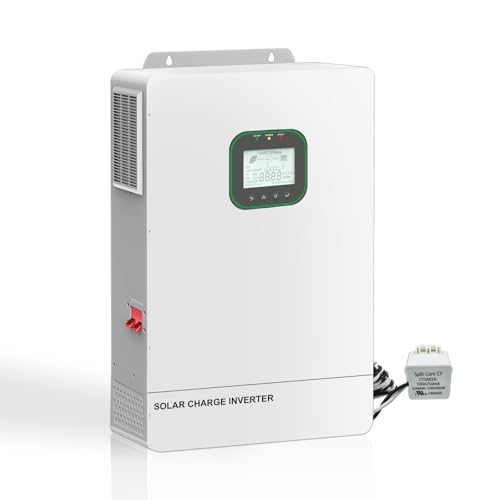
The POWLAND 6500W Solar Hybrid Inverter Charger delivers clean 120 V ± 5 % pure‑sine power while seamlessly integrating with the grid, solar panels, and a 48 V battery bank (lead‑acid or LiFePO₄). Its built‑in 120 A MPPT charge controller captures up to 22 A from a 120‑300 V PV array, and the anti‑backflow CT sensor lets the unit feed excess energy back to the grid safely. A bright LCD shows real‑time power flow, battery state‑of‑charge, and solar harvest, while Wi‑Fi (via an optional dongle) enables remote monitoring through the dedicated app.
Designed for scalability, up to six inverters can be paralleled for a combined 39 kW output, supporting both single‑phase (120 V) and split‑phase (120 V/240 V) configurations—perfect for whole‑home backup. Robust protection layers include overload, over‑temperature, short‑circuit, over‑current/over‑voltage PV safeguards, and night‑reverse‑current blocking. An intelligent variable‑speed fan kicks in at 104 °F (40 °C), cooling 30 % faster than typical units, eliminating overheating concerns.
Pros
- Grid‑tied hybrid operation with anti‑backflow CT sensor for safe net‑metering.
- High power density: 6500 W continuous output plus up to 39 kW when stacked.
- Comprehensive protection (overload, temperature, PV over‑current, reverse‑current) and fast‑acting cooling.
Cons
- Wi‑Fi functionality requires purchasing an additional dongle.
- Installation and parallel stacking may need a qualified electrician for optimal safety and code compliance.
2. SUNGOLDPOWER 10000W DC Solar Inverter
The SUNGOLDPOWER 10 kW DC 48 V UL1741 inverter is a true all‑in‑one solution for off‑grid, hybrid, or backup power systems. It combines a 10 kW pure‑sine‑wave inverter, a 200 A battery charger, and two built‑in MPPT solar controllers, all housed in a compact split‑phase (120 V/240 V) or single‑phase (120 V) chassis. With a maximum PV open‑circuit voltage of 500 VDC, the unit can handle large solar arrays, and its Wi‑Fi module lets you monitor performance and adjust settings from a mobile app. Four flexible charging modes (Hybrid, Utility‑Priority, Solar‑Priority, Solar‑Only) and four output modes let you tailor energy flow to your utility rates, while the time‑slot charging/discharging feature optimises usage during peak‑off‑peak periods. The inverter is compatible with AGM, gel, flooded, lithium, and even battery‑free configurations, and it supports CAN, USB, and RS‑485 communication for seamless integration with SunGoldPower battery packs.
Pros
- All‑in‑one design – inverter, charger, and dual MPPT controllers in a single enclosure saves space and wiring complexity.
- Smart energy management – multiple charging/output modes and time‑slot scheduling maximize cost‑effective use of solar and grid power.
- Robust protection & scalability – overload, over‑voltage, and over‑current safeguards plus parallel operation of up to six units for future expansion.
Cons
- High upfront cost – the integrated feature set and 10 kW capacity come with a premium price tag compared to basic inverters.
- Complex setup – configuring the various charging and output modes may require a learning curve for users new to hybrid systems.
1. Aninerel 12000W Solar Hybrid Inverter

The Aninerel 12000W Solar Hybrid Inverter transforms 48 V DC from solar panels or batteries into clean 120 V single‑phase or 240 V split‑phase AC. It delivers 12 kW continuous (24 kW peak) power, enough to run heavy‑duty appliances, workshop tools, and everyday loads. Two high‑efficiency MPPT controllers harvest up to 6 kW + 6 kW of PV input (max 500 VDC) and charge batteries at 220 A, boosting solar capture by up to 30 % compared with conventional chargers. The unit can operate without batteries for direct solar‑to‑load use and works with AGM, GEL, lead‑acid, Li‑ion and LiFePO₄ packs.
A sleek OLED touch screen provides real‑time data, while optional Wi‑Fi lets you monitor performance from any device. The IP65‑rated enclosure and smart variable‑speed cooling keep the inverter safe and reliable in indoor or semi‑outdoor settings. Up to six inverters can be paralleled, scaling total output to 72 kW and even enabling 208 V three‑phase power for larger residential or light‑commercial systems. With over‑95 % efficiency and UL1741 certification, it meets stringent safety and performance standards.
Pros
- Massive, scalable power – 12 kW per unit, expandable to 72 kW by paralleling up to six units.
- Dual MPPT + 220 A battery charging – maximizes solar harvest and provides fast, flexible battery charging.
- User‑friendly interface & remote monitoring – OLED touch screen and Wi‑Fi connectivity simplify setup and oversight.
Cons
- Higher upfront cost – the advanced features and high power rating make it pricier than basic inverters.
- Requires 48 V battery bank – systems using other voltages will need additional conversion equipment.
Buying Guide
When choosing the best split‑phase inverter, focus on how efficiently it converts DC to AC power, its compatibility with your load, and the reliability of its safety features. A well‑matched inverter will protect your equipment and deliver consistent performance over time.
- Power rating and efficiency – Select an inverter whose continuous wattage exceeds your peak demand and that offers at least 90 % conversion efficiency to minimize energy loss.
- Waveform quality – Pure sine‑wave output is essential for sensitive electronics; modified sine‑wave models are cheaper but can cause noise or reduced lifespan.
- Durability and protection – Look for robust cooling, overload, short‑circuit, and over‑temperature safeguards, as well as a solid enclosure rated for outdoor or industrial use.
- Installation flexibility – Features such as remote monitoring, adjustable voltage settings, and easy wiring simplify setup and future upgrades.
- Customer feedback and warranty – Prioritize units with strong user reviews and a warranty of three years or more, indicating manufacturer confidence and after‑sales support.
By weighing these factors—efficiency, waveform, durability, flexibility, and proven reliability—you’ll select a split‑phase inverter that delivers safe, long‑lasting power for your specific needs.
Frequently Asked Questions
What is a split‑phase inverter and how does it differ from a single‑phase inverter?
A split‑phase inverter converts DC power from a solar array (or battery bank) into two 120 V AC legs that are 180° out of phase, creating a 240 V split‑phase service typical in North American homes. Unlike a single‑phase inverter, which supplies only one 120 V leg, a split‑phase unit can directly feed both 120 V circuits and 240 V appliances (e.g., electric ranges, dryers, heat pumps) without additional transformers or phase‑converters.
What are the most important factors to consider when choosing the best split‑phase inverter for a residential system?
- Efficiency rating – Look for an inverter with ≥ 96 % CEC‑rated efficiency; higher efficiency means more usable energy and lower operating costs.
- Continuous power rating – Match the inverter’s kW rating to the total DC capacity of your PV array, allowing for a 10‑20 % safety margin.
- Voltage range & MPPT capability – A wide input voltage window and multiple MPPT trackers maximize energy harvest under varying irradiance and shading conditions.
- Grid‑support features – Ensure the inverter supports the required grid codes (e.g., IEEE 1547, UL 1741 SA) and offers functions like reactive power control, low‑voltage ride‑through, and optional backup (grid‑forming) mode.
- Warranty & service – Reputable manufacturers typically provide 10‑year warranties with the option to extend; check the availability of local service technicians and spare parts.
- Monitoring & communications – Built‑in Wi‑Fi, Ethernet, or cellular connectivity with a user‑friendly portal (or integration with platforms like SolarEdge, Enphase, or SMA) helps you track performance and troubleshoot remotely.
Which split‑phase inverter models are currently regarded as top performers for residential use?
| Brand / Model | Peak Efficiency | Continuous Power (kW) | Notable Features |
|---|---|---|---|
| SolarEdge SE7600H-US | 99.5 % | 7.6 | Dual‑MPPT, integrated rapid shutdown, Smart Energy Management, optional battery‑back‑up kit |
| SMA Sunny Boy 7.0-US | 97.5 % | 7.0 | SMA‑OS, Grid Guard, optional Sunny Island hybrid backup, robust warranty (10 yr) |
| Fronius Primo 7.0‑1 | 98.1 % | 7.0 | SnapINverter design, integrated Wi‑Fi, advanced grid support (UL 1741 SA), easy service access |
| Enphase IQ8+ (2‑phase) | 97 % (per micro‑inverter) | Scalable up to 10 kW total | Fully modular, grid‑forming capability, built‑in battery integration, extensive monitoring |
| ABB UNO‑DT 6.0‑T | 96.8 % | 6.0 | Dual‑track MPPT, compact footprint, optional AC battery interface |
These models consistently receive high marks for efficiency, reliability, and customer support in 2024‑2025 industry surveys. The “best” choice ultimately depends on your system size, local code requirements, and whether you plan to add battery storage or advanced grid services.
Conclusion
Choosing the right split‑phase inverter hinges on balancing efficiency, reliability, and future‑proofing rather than chasing the lowest price tag. Prioritize units that deliver high conversion rates, robust thermal management, and comprehensive warranties, as these factors translate directly into long‑term savings and peace of mind. Compatibility with your existing solar array and ease of installation can dramatically reduce setup time, while integrated monitoring tools empower you to optimize performance day by day. Ultimately, a well‑matched inverter should seamlessly integrate into your energy ecosystem, offering dependable power delivery, scalable options for expansion, and responsive support that keeps your system running at its best for years to come.