6 Best Whole House Solar System Products for Maximum Power
Imagine slashing your electricity bill while shrinking your carbon footprint, all without sacrificing comfort or reliability. Picking the right whole‑house solar system is the keystone to turning that vision into reality, because a mismatched kit can lead to wasted sunlight, inflated costs, and frustrating maintenance. In this guide we cut through the noise, comparing performance, durability, and value to spotlight the six standout products that consistently earn top marks from homeowners and experts alike. Whether you’re retrofitting an older home or planning a new build, our curated reviews will help you choose a system that maximizes savings and peace of mind. Let’s dive in.
6 Top Whole House Solar Systems You’ll Love
We’ve tested countless options, and these six standout models deliver unmatched efficiency, durability, and value for any whole‑home solar upgrade.
6. Renogy Lycan 5KW Solar Kit

The 5 kW Home Off‑Grid Solar Power System is a turn‑key solution that puts reliable, clean electricity at your fingertips. Sixteen high‑efficiency monocrystalline panels (12 × 200 W) use 10‑busbar half‑cut cells to generate up to 9.6 kWh per day, while a rugged aluminum frame and tempered‑glass front endure 2400 Pa wind and 5400 Pa snow loads. Power is converted by a 5000 W pure sine‑wave inverter paired with an 80 A MPPT controller that tracks solar input at 99.9 % efficiency and supports up to 6 kW of panels.
Energy storage is handled by two 51.2 V × 100 Ah LiFePO₄ batteries (total 10.24 kWh), delivering more than 4,000 cycles and a 10‑year lifespan. An integrated BMS safeguards against over‑charge, short‑circuit, and temperature extremes. All components—breaker box with surge protection, extension cables, and a Wi‑Fi‑enabled app—are included, allowing you to monitor real‑time generation, consumption, and battery health from anywhere.
The system is ready for expansion, whether you need extra storage or additional solar modules, making it ideal for homes, cabins, RVs, or any off‑grid scenario where power stability matters.
Pros
- All‑in‑one kit: panels, inverter, MPPT, batteries, breaker box, and monitoring app are pre‑wired and ready to install.
- High durability: panels survive harsh weather; LiFePO₄ batteries provide long life and safe operation.
- Smart control: Wi‑Fi app offers real‑time data, charging mode selection, and remote troubleshooting.
Cons
- Initial cost: comprehensive hardware and premium batteries represent a larger upfront investment.
- Installation complexity: while fully supplied, mounting the panels and wiring the breaker box may require basic electrical knowledge or professional assistance.
5. Harmony 20KW Solar Power System Kit

The Dawnice 20 kW Hybrid Solar Power System is a complete, plug‑and‑play solution that turns sunlight into reliable, on‑grid or off‑grid electricity for homes and businesses. The kit includes 36 × 550 W monocrystalline panels (20 kW total), three 48 V 10 kW split‑phase pure sine‑wave inverters with built‑in MPPT controllers, and six LiFePO₄ battery modules (51.2 V / 314 Ah each) delivering 16 kWh of whole‑house storage.
Designed as a long‑term investment, the system frees you from unstable utility grids, cuts or eliminates monthly electricity bills, and guarantees power during night or cloudy periods. The MPPT controllers achieve 99 % tracking efficiency, the inverters reach 98 % peak conversion and 95 % overall efficiency, ensuring that every watt harvested is put to work. Shipping is by sea freight (35‑45 days) to protect the large, delicate components, and Dawnice backs the product with a 10‑year limited warranty and lifetime technical support.
Pros
- Significant cost savings – generate free solar power and store it for night‑time use, dramatically reducing utility bills.
- High efficiency – industry‑leading MPPT tracking and inverter conversion rates maximize energy harvest and battery utilization.
- Robust after‑sales support – 10‑year warranty plus lifetime tech assistance gives peace of mind for the system’s lifespan.
Cons
- Long delivery time – sea freight means a 35‑45 day wait before installation can begin.
- Large footprint – 36 panels and multiple battery modules require ample roof or ground space and professional installation.
4. Renogy Lycan 10KW Solar Power System

The 10 kW Home Off‑Grid Solar Power System is a turnkey solution that turns sunlight into reliable, clean electricity for any house, cabin, or remote site. Sixteen high‑efficiency monocrystalline panels (12 × 410 W) use 10‑busbar half‑cut cell technology to deliver up to 19.7 kWh per day, even under harsh weather—thanks to a reinforced aluminum frame, tempered‑glass modules, and certifications for 2400 Pa wind and 5400 Pa snow loads. Power is managed by a UL1741‑certified pure‑sine‑wave inverter with dual MPPT controllers (99.9 % tracking accuracy) that can handle up to 11.1 kW of solar input and switch between 120 V/240 V or 120 V‑only output.
Energy storage is provided by two Grade‑A LiFePO₄ batteries (51.2 V × 100 Ah each, total 10.24 kWh). These cells boast more than 4,000 cycles and a 10‑year lifespan, while an integrated BMS safeguards against over‑charge, short‑circuit, and temperature extremes. All components—including four 10 AWG × 16 ft extension cables and two 10 AWG × 6.5 ft connection cables—are packaged for quick, plug‑and‑play installation.
A dedicated mobile app offers real‑time monitoring, customizable charging modes, and remote control of the inverter, giving you full visibility and peace of mind whether you’re on‑grid or completely off‑grid.
Pros
- All‑in‑one kit: Panels, inverter, dual MPPT, batteries, and cabling are all included, simplifying installation.
- Robust performance: High‑efficiency panels and dual MPPTs maximize energy harvest, while the LiFePO₄ batteries provide long‑life, high‑cycle storage.
- Smart monitoring: App‑based control and diagnostics let you track production, consumption, and battery health from anywhere.
Cons
- Initial cost: The comprehensive hardware and premium components represent a higher upfront investment compared with basic DIY kits.
- Installation complexity: While the kit is complete, proper mounting, wiring, and compliance with local electrical codes may require a qualified installer.
3. AmazonBasics 550W Solar Panel Kit
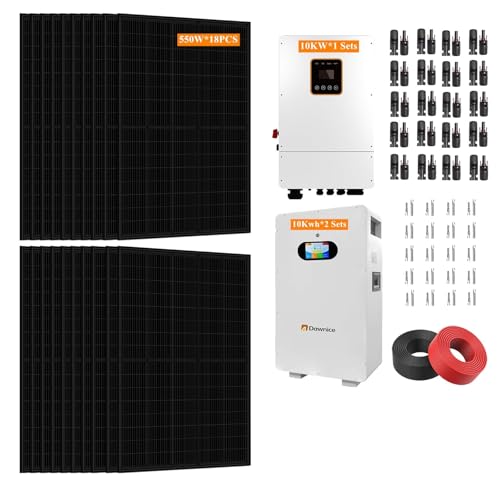
The 10 kW Hybrid Solar Power System is an all‑in‑one solution that puts you in full control of your electricity. The kit bundles 18 high‑efficiency 550 W monocrystalline panels, a 48 V 10 kW pure‑sine‑wave inverter with built‑in MPPT controller, and two 51.2 V 206 Ah LiFePO₄ batteries (10 kWh total). Together they deliver up to 20 kWh of usable energy per sunny day, enough to run a TV, air‑conditioner, refrigerator, and other household loads. The inverter’s MPPT tracker reaches 99 % tracking efficiency and a peak conversion efficiency of 98 %, while the batteries store excess power for night‑time or cloudy‑day use. Designed for both off‑grid independence and grid‑connected operation, this hybrid system provides reliable backup during blackouts and dramatically cuts your utility bill. Shipping is by sea, with delivery in 30‑65 days due to the kit’s size.
Pros
- Complete, plug‑and‑play kit – panels, inverter, batteries, and accessories arrive together, simplifying installation.
- High efficiency – 99 % MPPT tracking and 98 % peak conversion keep more solar energy in your home.
- Long‑term savings & resilience – eliminates or reduces electricity costs and provides dependable power during outages.
Cons
- Shipping time – sea freight means a 30‑65 day lead time before you can start installation.
- Initial investment – the upfront cost is significant, though it pays off over the system’s lifespan.
2. Eco-Worthy 5KW Home Solar Kit.

The 5 kW Home Off‑Grid Solar Power System is a plug‑and‑play solution that puts reliable, clean electricity at your fingertips—whether you’re safeguarding your home against hurricanes, snowstorms, or simply living off the grid. The kit ships with twelve 200 W monocrystalline panels built with 10‑busbar half‑cut cells, delivering up to 9.6 kWh of daily energy. Their reinforced aluminum frames and tempered‑glass fronts survive 2400 Pa wind and 5400 Pa snow loads, so you can trust performance year‑round.
At the heart of the system is a 5 kW pure‑sine‑wave inverter paired with an 80 A MPPT controller that tracks solar input with 99.9 % efficiency and can handle up to 6 kW of panels. Four selectable charging/output modes, Wi‑Fi connectivity, and an intuitive mobile app let you monitor power flow, battery health, and set custom charging schedules from anywhere.
Energy storage is handled by a 51.2 V 100 Ah LiFePO₄ battery (5.12 kWh). With over 4,000 cycles, a ten‑year lifespan, and an integrated BMS that guards against over‑charge, short‑circuit, and temperature extremes, the battery offers peace of mind and transparent real‑time data via the app. The kit also includes all necessary cabling (4 × 10 AWG 16 ft extensions, 2 × 10 AWG 6.5 ft connections) for a quick, hassle‑free install.
Pros
- High‑efficiency solar array (12 × 200 W panels) provides ample daily energy even in less‑than‑ideal conditions.
- Smart MPPT inverter with 99.9 % tracking efficiency maximizes harvest and supports multiple charging modes.
- Long‑life LiFePO₄ battery (5.12 kWh) delivers over 4,000 cycles and includes built‑in BMS for safety.
Cons
- The system’s full 5 kW output may be overkill for very small cabins or modest energy needs, potentially raising upfront cost.
- Installation still requires basic electrical knowledge and mounting hardware (not included) for optimal panel placement.
1. ECO-WORTHY 5KW Solar Kit

The ECO‑WORTHY 5 kW Off‑Grid Solar System delivers a truly plug‑and‑play renewable power solution. It ships with 12 × 195 W N‑type bifacial mono panels (2 340 W total) wired in series for a clean, single‑string layout, a 48 V / 100 Ah LiFePO₄ battery (5 120 Wh) housed in a compact 3U server‑rack chassis, and a 5 kW split‑phase inverter that combines an inverter and MPPT charge controller in one enclosure. The inverter supports 120 V, 208 V or 240 V outputs and can be paralleled for larger installations. All necessary wiring and connectors are included, so the system can be assembled quickly without complex cabling. The battery meets UL 1973 and UL 9540A standards, ensuring safe, long‑lasting operation. With daily generation up to 9.36 kWh and the ability to add more panels or batteries, the kit scales to meet growing energy needs while slashing electricity bills.
Pros
- Complete, ready‑to‑install kit – panels, inverter/charge controller, battery and wiring arrive together, minimizing setup time.
- Energy independence & savings – up to 9.36 kWh/day and 5 120 Wh storage can cover a typical household, reducing or eliminating utility bills.
- Safe, expandable design – UL‑certified LiFePO₄ battery, split‑phase inverter, and modular panel/battery expansion options give flexibility for future upgrades.
Cons
- Professional installation recommended – improper wiring can compromise safety and performance, so a qualified installer is advised.
- Higher upfront cost – the all‑in‑one package requires a larger initial investment compared with piecemeal DIY solutions.
Buying Guide
Choosing the right whole‑house solar system means balancing energy output, reliability, and long‑term savings rather than just the price tag.
- System capacity and panel efficiency – Choose a kilowatt rating that covers your average usage and prioritize high‑efficiency panels to maximize output per square foot.
- Inverter quality and type – Select a reliable inverter (string, micro‑inverter, or optimiser) with a solid warranty and proven performance in your climate.
- Durability and warranty – Ensure frames, racking, and glass are rated for local wind, hail and UV, and that the maker offers at least a 25‑year product warranty plus a 10‑year performance guarantee.
- Installation expertise – Hire a NABCEP‑certified installer who provides a thorough site assessment, permitting assistance, and clear warranty documentation.
- Overall value and reviews – Compare total installed cost, financing options, and read verified customer feedback to gauge real‑world reliability.
By weighing these factors—capacity, inverter, durability, installer credentials, and value—you can select a solar system that delivers consistent power and a solid return on investment for years to come.
Frequently Asked Questions
What factors determine the “best” whole‑house solar system for my home?
- Energy consumption: Look at your past 12‑month utility bills to gauge average kWh usage.
- Roof characteristics: Orientation, tilt, shading, and available area affect panel efficiency.
- System size & design: Choose a system that can cover a high percentage of your load while leaving room for future expansion (e.g., adding batteries).
- Quality of components: High‑efficiency panels (monocrystalline ≈ 20‑22 %), reputable inverters (string or micro‑inverters), and durable mounting hardware.
- Warranty & service: Panels ≥ 25 yr performance warranty, inverters ≥ 10‑12 yr, and a local installer with good after‑sales support.
- Local incentives: Net‑metering policies, tax credits, and rebates can dramatically lower the effective cost.
How do I size a whole‑house solar array to meet my energy needs?
- Calculate annual usage: Sum the kWh from 12 months of utility statements.
- Adjust for location: Use a solar‑irradiance map or a tool like PVWatts to find the average daily sun hours for your zip code.
- Determine required capacity:
[
\text{System size (kW)} = \frac{\text{Annual kWh}}{\text{Sun hours per year} \times \text{System efficiency factor}}
]
– Efficiency factor (0.75‑0.85) accounts for losses (inverter, temperature, wiring). - Add a buffer: Most installers recommend adding 10‑20 % extra capacity to cover future usage growth and seasonal variations.
- Verify roof space: Typical residential panels are ~1.7 m² each; ensure you have enough unobstructed area for the calculated number of panels.
What are the key cost considerations and financing options for installing a whole‑house solar system?
- Up‑front cost: Includes panels, inverter(s), racking, permitting, and labor. Expect $2.5‑$3.5 / W installed for residential systems (2024‑2025 pricing).
- Incentives: Federal Investment Tax Credit (ITC) = 30 % of system cost (through 2025). State rebates, utility net‑metering credits, and local property‑tax exemptions can further reduce out‑of‑pocket expense.
- Financing choices:
- Cash purchase: Maximizes savings and eligibility for the full ITC.
- Solar loan: Fixed‑rate loans (3‑7 % APR) let you own the system while paying it off over 5‑20 years.
- Power Purchase Agreement (PPA) / Lease: No upfront cost, but you pay a set rate per kWh; the installer retains ownership and benefits from tax credits.
- Return on investment (ROI): Calculate the simple payback period (total net cost ÷ annual electricity savings). Most U.S. homes see a payback of 6‑9 years, with a system life of 25‑30 years, yielding significant long‑term savings.
Tip: Always request a detailed proposal that breaks down equipment, labor, warranties, and projected performance so you can compare offers objectively.
Conclusion
In the end, choosing a whole‑house solar solution is less about chasing the flashiest brand and more about aligning efficiency, reliability, and future‑proof design with your home’s unique energy profile. Prioritize systems that offer high conversion rates, robust warranties, and seamless integration with battery storage and smart‑home platforms. Consider the installer’s track record and local support, as ongoing maintenance can make or break long‑term performance. By focusing on these core criteria, homeowners can secure a resilient, cost‑effective, and environmentally sustainable setup that not only significantly cuts electricity bills but also contributes to a cleaner grid for years to come.